
How Funding Stage Reshapes the Equity Upside Math for ML Engineers Choosing Between Series A and Series B
A bigger grant can be worth less once dilution and exit odds count.
For ML engineers choosing between Series A and Series B AI startups, an offer with a bigger equity percentage can still be worth less. Which offer is better depends on ownership after dilution, valuation growth, exit probability, and the terms that set how much employees get. Base salary and the available FAANG or frontier lab alternative set the price of taking that bet.
Why the stage of a startup's last round changes what equity is actually worth at exit
An engineer holds two offers, one from a 30-person Series A company and one from a 90-person Series B company. The earlier company offers a larger percentage. The later company offers a smaller stake in a business that has already reached another funding round. Which equity number is better?
The tempting shortcut is to treat stage as a risk dial, with earlier entry buying more danger and more upside. But the relationship is not that simple. Series A and Series B median valuations have a substantial and growing gap, so a percentage point represents different paper values at each stage. Those paper values are only starting points. The engineer needs to judge what could reach employee shareholders.
What the grant percentage benchmarks actually look like by stage, before any adjustments
For the Founding AI/ML Engineer role archetype, the equity benchmarks are 0.2%–0.75% at Series A and 0.05%–0.35% at Series B. The role is part of the comparison. An engineer using these figures needs to distinguish a founding position from an ML engineering position with a different scope.
The title also describes a stage of company building. “Founding AI Engineer” is not merely a label for technical seniority, so the ownership benchmark belongs with the stage and responsibilities attached to the offer. The ranges overlap, even though they compress between rounds. At this point, the numbers establish the raw grant comparison, before future financing, valuation growth, or exit terms change its dollar value.
How dilution, valuation step-up, and exit probability interact to produce the number that actually matters
Dilution is the first adjustment because the grant percentage does not stay fixed through future funding rounds. Each subsequent round reduces the engineer’s ownership stake, while the employee option pool grows meaningfully from seed through Series C. Series A leaves more dilution ahead. However, the earlier engineer also participates in more of the valuation appreciation that makes those rounds possible. Counting the dilution without that appreciation would distort the comparison in the opposite direction.
To make the logic concrete, consider a founding engineer starting with a 0.2% Series A grant. Later financing shrinks that stake, but the company’s valuation may grow a lot over the same time. The smaller percentage can then be worth more in dollars than the original percentage at the earlier valuation. Growth can outweigh the loss of ownership. A larger grant at a stagnant company does not get that benefit.
Probability is the next adjustment, and it changes the interpretation of that dollar value. Cadence’s 2026 FAANG vs. startup compensation analysis describes the median startup employee outcome as an acquihire, where founders recover value but employees mostly do not, or a shutdown. The analysis puts risk-adjusted startup equity value at roughly zero at the median, with life-changing outcomes at the 99th percentile. Paper value is not spendable compensation. Treating it like liquid stock skips the possibility that the employee never receives a meaningful payout.
The objection is that higher probability at Series B comes with lower upside. That expected-value tradeoff requires a judgment about the company. A Series B business with strong product-market fit, a believable path to an exit, and a clear cap table may have better risk-adjusted equity value than a Series A business still trying to prove its core thesis. The reverse depends on the earlier company’s growth and exit prospects.
What base salary does to the equity calculation at each stage, and why it changed recently
Cash changes how much work the equity must do. Series A startups that raise typical early amounts should aim for base salaries high enough to draw in passive candidates, while larger Series B raises let them pay bases close to those at growth-stage AI companies. With a higher Series B base, less of an equity premium is needed to make that offer worth taking. The comparison is therefore not just between two uncertain payouts.
The old Series A bargain has also weakened. A senior ML engineer at a well-funded Series A company can now earn total compensation that would have been reserved for Staff+ engineers at big tech companies three years ago. Even allowing for the distinction between total compensation and cash, the blanket assumption that early-stage work requires a large salary sacrifice is less useful than it was.
For the engineer, the practical rule is to establish the cash threshold first. Equity is not a substitute for a credible base at either stage, and the threshold for a credible offer has risen. Once both offers clear it, equity can become the differentiator. Series A equity can represent a meaningfully larger share of compensation, but realizing that share still depends on a qualifying exit.
What the competing alternative — frontier lab and FAANG comp — does to the opportunity cost of either choice
The relevant alternative may sit outside the startup market. The same Cadence analysis finds that FAANG pays the median engineer far more after risk is taken into account. For someone who can access that alternative, startup equity needs an enormous expected value to close the gap. Comparing only Series A with Series B hides that cost. Both startup packages may pay the engineer less in cash and liquid equity than another offer they could get.
Frontier labs push that benchmark higher still. Thinking Machines Lab, Mira Murati’s new lab, offered early technical hires exceptionally high base salaries, reframing what a high-cash package can look like at the extreme. That benchmark provides context for an outside option when an engineer could credibly obtain a lab offer. In that case, a startup payout that is uncertain and years away faces a much steeper hurdle.
Recruiting from Scratch’s ML salary guide frames the startup pitch around product ownership and equity in an earlier-stage company. That distinction is about the work, too. Engineers who want to build products rather than train foundation models may choose ownership, mission specificity, learning velocity, and a particular company they believe in. Their equity is a leveraged bet on that belief. Naming the foregone compensation makes that choice more deliberate.
How the specific mechanics of the offer — strike price, dilution protection, and exit structure — determine which stage actually wins for a given engineer
For an engineer evaluating an actual offer, the next step is to ask for the terms behind the percentage. The initial terms to examine are the strike price, its relationship to the current 409A valuation, and the option type. ISOs bring AMT exposure on exercise, while NSOs are taxed as ordinary income at exercise. Exercise can become a practical barrier. An engineer who leaves before an exit may be unable to afford exercising either type and may lose the options when they expire.
The engineer also needs to ask for the fully diluted ownership figure. A percentage quoted before dilution obscures the stake the engineer is actually receiving, so the headline grant should remain provisional until the fully diluted cap table is available. A larger printed number is not dilution protection. The engineer needs to assess what ownership it represents after the existing capital structure is accounted for, followed by what future financing could do to it. That distinction applies at both stages.
Double-trigger acceleration needs its own question when the offer is discussed. It is increasingly standard at Series A and above and offers protection when an acquisition happens before full vesting. The engineer should check that the offer includes it. This is a different issue from grant size or future dilution because it concerns what happens to unvested equity around an acquisition. An attractive percentage does not answer it.
The preference stack determines who stands ahead of employee common stock at exit. With investors’ liquidation preferences, employees can get far less than the headline acquisition value would lead them to expect. That can leave employees with less than they hoped for even at a moderate exit if a Series B company raised at high valuations with participating preferred stock. Ask what sits above common stock and how it affects the payout. An engineer reading the offer documents through these terms is evaluating a claim on proceeds.
How to read a specific offer against this framework — the questions that surface the real number
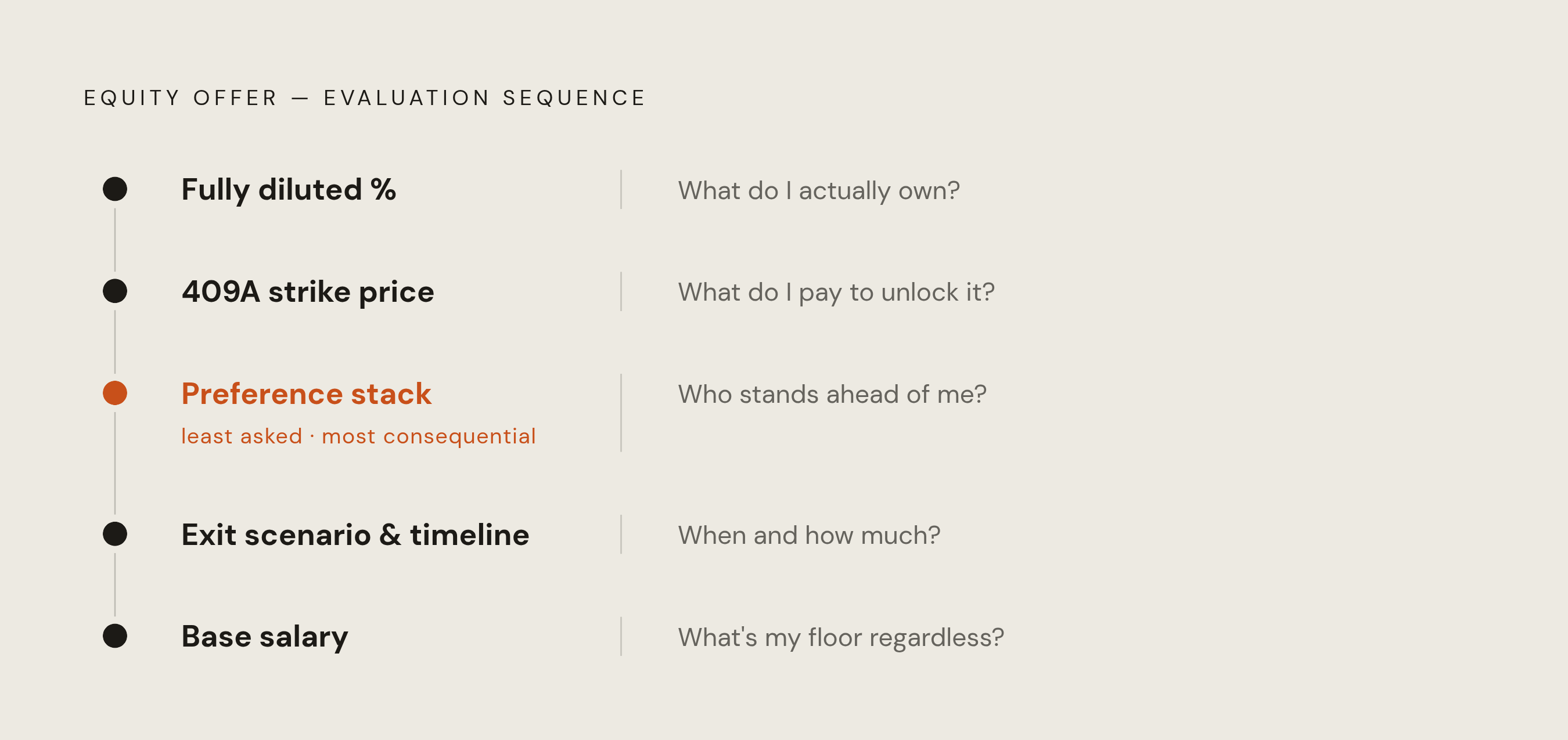
The evaluation starts with five inputs, considered in order. They are the fully diluted percentage, the 409A strike price relative to the valuation trajectory, the preference stack above common, the realistic exit scenario and timeline, and base salary as the cash floor. Each answers a different question. Together, they ground a Series A versus Series B comparison in the actual offers behind the stage labels.
First, ask for the fully diluted cap table. A company willing to share it readily signals confidence in its trajectory, while a refusal is information in its own right. Then examine the strike price and preference stack before estimating a payout. How much of the quoted ownership could produce money for the employee, under the terms being offered?
Next, model both a modest exit and a strong exit. The modest case should include acquihire territory, where the preference stack has the most influence on whether employees recover value. The strong case shows what happens when common shareholders clearly come out ahead. The gap exposes the cost of the preferences. An explicit timeline also keeps a distant possible payout distinct from compensation received during employment.
Apply an honest exit probability to those scenarios. The base rate is not encouraging at either stage, so a more optimistic estimate needs to reflect a view of the specific company. Then compare the risk-adjusted equity value with the difference in base salary. If Series B pays meaningfully more cash and the expected equity advantage at Series A is smaller, Series B wins despite its lower grant percentage. Run the comparison against an available FAANG or lab alternative at least once as well.
The salary guide emphasizes specific, honest equity math rather than vague upside claims as the way to move sophisticated ML engineers. Speed and candor are revealing when the questions become precise. When companies share salary bids and equity terms before several rounds of interviews, candidates can weigh the offer before they get attached to it.

