Preferred vs. Common Stock Liquidation Preferences and Engineer Payouts
Understanding how liquidation preferences shrink engineer payouts before common stock gets paid.
Preferred and common stock do not turn an ownership percentage into the same exit payout. Liquidation preferences sit between an engineer’s grant and the money it can return, so evaluating equity means tracing who gets paid first, how much they take, and what remains. For engineers considering opportunities through Fonzi or direct applications, the practical rule is the same. Treat the payout structure as the starting point.
Why preferred stock sits above engineer equity in the payout hierarchy
Venture investors get preferred stock with rights that common stock does not have, including liquidation preferences, anti-dilution adjustments and conversion rights, while engineers usually get options on common stock. Preferences limit what investors can lose by putting them first in the payout order, and the contract puts common stock last without judging what employees have contributed.
How the liquidation preference multiple sets the first hurdle engineers must clear
The liquidation preference multiple determines the size of that priority claim. The calculation starts with the investor’s original investment and applies the agreed multiple to it. That preference amount must be paid before common holders get any proceeds as long as the investor keeps that preference. The percentage can look identical on an offer while the amount ahead of it changes substantially.
That protection does not mean an investor always takes the preference payout. At a sufficiently large exit, converting to common stock can return more than collecting the fixed preference amount. Crowley Law explains that the investor compares those outcomes and chooses the larger return. When conversion wins, the investor gets a share of the total proceeds based on how much of the company they own. Preferences therefore matter most in lower and middle outcomes.
At the conversion breakeven point, the investor’s share of the exit equals the preference amount. To identify it, divide the preference amount by the investor’s ownership share on conversion. Below that point, the preference offers the investor more protection than common ownership would provide. Above it, the ownership share produces the larger payout. Engineers should find this threshold before weighing an offer, because even a realistic exit estimate says little unless they know which payout path it would take.
That threshold is not the same as the point where common stock first receives anything. Common can receive a remainder after a preference is paid even when the investor has no reason to convert. Keeping those two thresholds separate prevents a basic modeling error. One tells the engineer when money can reach common stock, while the other tells them when the investor would rather share the whole exit as common.
How participating preferred takes a second cut from what remains after the first
The choice between a preference and conversion describes non-participating preferred. Crowley Law identifies this as the industry standard and explains that investors cannot take both payouts under that structure. Participating preferred changes the rule by allowing the investor to collect the preference and then share in the remaining proceeds. First Citizens Bank characterizes this as “double-dipping”. Two deals with the same preference multiple can therefore leave different amounts for employees.
The arithmetic follows the order in which the money moves. First, subtract the investor’s preference amount from the exit proceeds. Next, multiply the proceeds that are left by the investor’s ownership share to find the additional participation payout. Add that amount to the preference to find the investor’s total, leaving the balance for common holders in the single-investor example. The second cut comes from money that would otherwise remain for common after payment of the preference.
This distinction matters especially when the exit is large enough to leave a remainder but not large enough to make the preference unimportant. An engineer who checks only the multiple misses the second deduction.
Participation caps can limit that effect, so engineers should ask whether a cap exists rather than treating all participating terms as identical. The answer belongs in the payout calculation together with the multiple and the ownership share. Participation calls for calculating the remaining pool under the actual terms before applying the headline percentage to any proceeds.
How the preference stack compounds across multiple funding rounds
A startup with several funding rounds has several preferred claims. Seed, Series A and Series B each add a layer, and the total preference stack is the sum of those claims. As a result, the latest valuation says little about how much value must clear the stack before employees receive anything. Engineers should ask for the total in dollars and model it against an expected exit price.
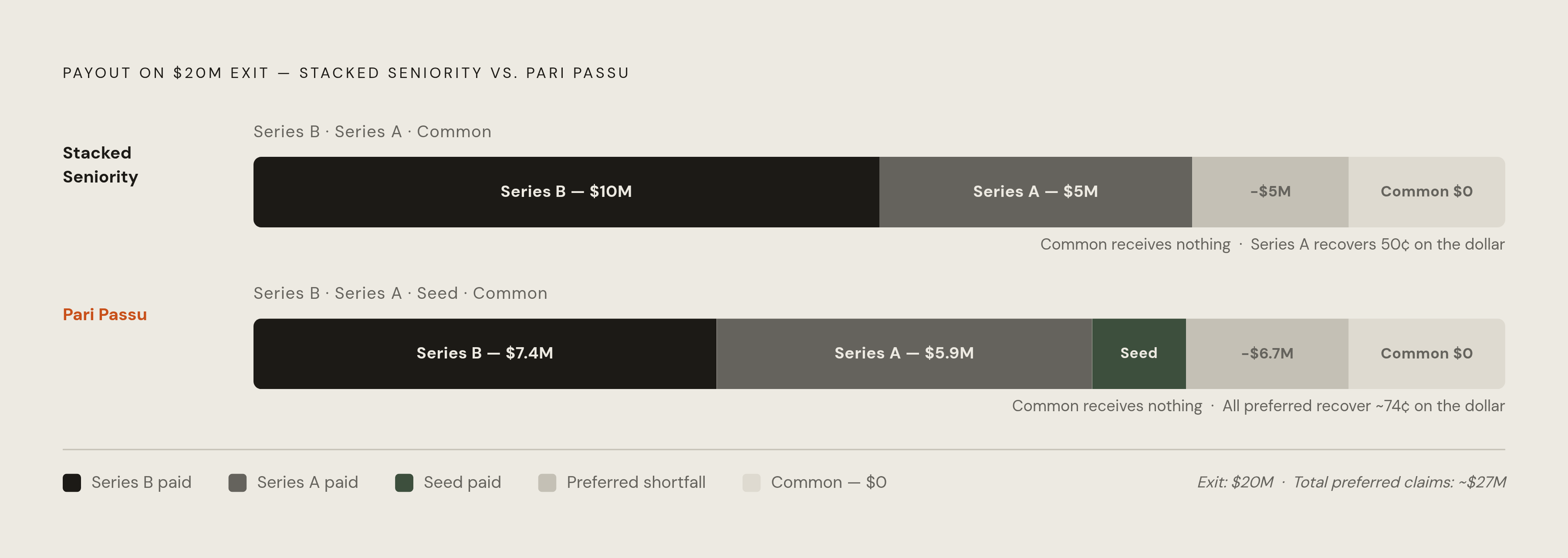
Crowley Law distinguishes stacked seniority from pari passu treatment. Under stacked seniority, the latest round is paid first, so Series B receives its full preference before Series A, with Seed last among preferred. Under pari passu treatment, preferred holders have equal priority and share proportionally when proceeds cannot cover their claims. Neither arrangement moves common ahead of preferred.
Crowley Law’s table illustrates the difference using $20 million in total preferences. Under stacked seniority, Series B gets paid in full, Series A gets roughly half of what it is owed, and common gets nothing. Under pari passu treatment, each preferred class gets roughly three-quarters of what it is owed, and common still gets nothing. Changing seniority redistributes the loss among investors in this example. It does not create a remainder for employees.
A down round can make this burden harder to clear because a new senior layer sits above preferences tied to earlier investment amounts. Those earlier claims do not shrink or reset just because the company raises at a lower valuation. A company can therefore raise tens of millions across rounds, announce a large acquisition, and still leave employees with nothing if the sale price is below the stack. Only the most senior preferred holders may get any money, depending on seniority and how much there is to pay out.
The equity stack is also not the whole payout hierarchy. Capbase places senior debt before preferred classes and common last. Fonzi’s original research into engineering organization composition includes how those organizations are capitalized. For an offer evaluation, that context matters because the grant’s place in the structure is as important as its size.
Why the 409A valuation gap makes the preference stack's effect on an offer harder to see
An offer can obscure these differences by attaching a preferred-stock price to common-stock options. First Citizens Bank notes that early-stage common stock has historically been priced at a fraction of the preferred price. The two prices refer to instruments with different rights. If a recruiter values the grant using the latest preferred price, that figure can overstate the engineer’s position at the time of the offer. The investor paid for protections the employee’s common stock does not have.
The 409A valuation supplies the common-stock value used to set the option strike price. That makes it a useful contrast with the last preferred round price, but neither price alone predicts an exit payout. The waterfall still determines how much reaches common stock when the company sells. After that, the cost of exercising the options is a further deduction from what the engineer receives. A quoted grant value that ignores that cost is not a net compensation figure.
The practical response is to ask what price supports the quoted value and what rights support that price. Engineers should ask for the total liquidation preference stack in dollars, the 409A common-stock price, the last preferred round price and the options’ strike price. They should also request the participation structure of each round and the fully diluted cap table. Those details connect the offer’s ownership claim to the claims ahead of it.
What the current term-sheet environment means for engineers joining AI startups now
The current market offers some good news about the terms themselves. Crowley Law says non-participating, single-multiple liquidation preferences are by far the most common terms in U.S. venture rounds. The harsher preference features have receded from their peak, making clean terms a more common starting point. That reduces the concern that an investor will both take a preference and collect a second share of the remainder. It does not remove the first claim on proceeds.
With so much venture capital going into AI, companies can raise several large rounds close together and build preference stacks faster than earlier generations of startups did. Each round can have clean terms while the total dollar claim grows hard to clear. Checking each round in isolation can therefore miss the problem created by all of them together.
Engineers joining at the founding or early stage face this tension directly. They may receive the largest grants, but aggressive later fundraising can place a steep stack ahead of those grants. For that reason, favorable terms today do not settle what the grant will return after further rounds. Evaluating an AI startup requires attention to both the terms of its capital and the amount accumulating ahead of common stock.
The five questions engineers should work through before treating startup equity as real compensation
Engineers should first ask how large the total liquidation preference stack is in dollars across all funding rounds. Engineers should weigh that claim against the price they expect the company to sell for. If they cannot establish the amount ahead of common, they should treat the equity as a possible bonus.
Second, engineers should ask whether each round has participating or non-participating preferred, and whether any participation has a cap. With non-participating preferred, investors stop after collecting a preference, while with participating preferred, they also take money from the remainder. The multiple alone cannot answer it. A usable model needs both the first claim and any right to a second cut.
Third, engineers should ask how the 409A common-stock price compares with the latest preferred price, and what strike price applies to the options. This shows whether the quoted offer value is based on the price of what the engineer will actually hold. It also identifies the exercise cost that must be deducted.
Fourth, engineers should ask whether preferred classes rank by stacked seniority or pari passu treatment, and which round is senior. This shows where a shortfall lands before any proceeds could reach employees. An exit below the stack can leave earlier preferred holders, as well as common holders, with no payout.
Fifth, engineers should ask at what exit price the preference stack clears and common stock begins receiving proceeds. This is the common-stock payout threshold, distinct from an investor’s conversion breakeven point. It turns the earlier answers into a concrete test of the offer. Engineers should compare that threshold with an expected exit.
For candidates using Fonzi, curated matching with AI startups and high-growth tech companies, along with interview requests that include salary bids upfront, gives them a place to start when discussing an offer. Engineers who apply directly or speak with recruiters still need to ask the same preference questions. A company that refuses cap table information or cannot explain its terms gives a signal about transparency that belongs in the evaluation.
Understanding this structure is a prerequisite for judging whether a particular grant is worth the risk. Engineers who know the waterfall are better positioned to evaluate and negotiate than those relying on headline numbers. Ownership describes a share of the company, but the payout terms determine what that share can return.