
What Fully Diluted Shares Outstanding Means for Your Percentage
The percentage you're quoted depends on which share count the company uses as its denominator.
An offer letter quotes you 0.5% of the company. You assume that number means something fixed. It does not, because the percentage depends entirely on which share count the company used as the denominator. Two companies can quote you 0.5% and hand you materially different stakes.
Why the denominator in your equity percentage matters more than the percentage itself
The percentage on your grant letter is an answer to a division problem you never saw written down. Your shares go in the numerator. Some count of total shares goes in the denominator. Change the denominator and the percentage moves, even though your share count stays exactly the same. One company might divide your grant by the shares currently held by shareholders. Another might divide by every share that could exist if all options, warrants, and convertible instruments converted tomorrow. Both can honestly print "0.5%" on a piece of paper.
The gap between those two methods is not cosmetic. It is the difference between owning 0.5% of what exists today and owning materially less of what the company will actually be. And it operates before a single future funding round closes. What looks like a clear number on the page is really a claim about which denominator matters, and the company gets to choose that denominator unless you ask.
The four share counts a cap table contains, and why three of them can mislead you
Startups maintain four distinct share counts, nested inside one another. Confusing them is the root of most equity misreads, and three of the four will give you a misleading picture of what you own. Authorized shares are the legal ceiling set in the certificate of incorporation. It cannot issue more than that unless it amends its charter and gets shareholder approval. This number has no direct relationship to anyone's ownership. It is the cap on how much could exist, not a measure of what does.
Issued shares are every share the company has granted or sold. Outstanding shares are the subset currently held by shareholders, which is issued shares minus any treasury shares the company has repurchased. For most early-stage startups, issued and outstanding are identical because share repurchases are rare before later funding stages. Unexercised stock options are not outstanding shares. They are contracts giving someone the right to purchase shares, and the shares only become issued when that person exercises and pays.
Fully diluted shares are the number that actually matters. This count includes all outstanding shares plus every share that would exist if all options, warrants, SAFEs, and convertible notes were converted or exercised today. That means granted and ungranted option pool shares alike. The full list runs like this: all outstanding shares, all reserved option pool shares whether granted or not, all SAFE conversion shares, all convertible note conversion shares, and any outstanding warrants. Investors, term sheets, and professional cap tables all use the fully diluted count. So whatever someone quotes you on an outstanding basis is almost certainly bigger than the number a serious counterparty is looking at.
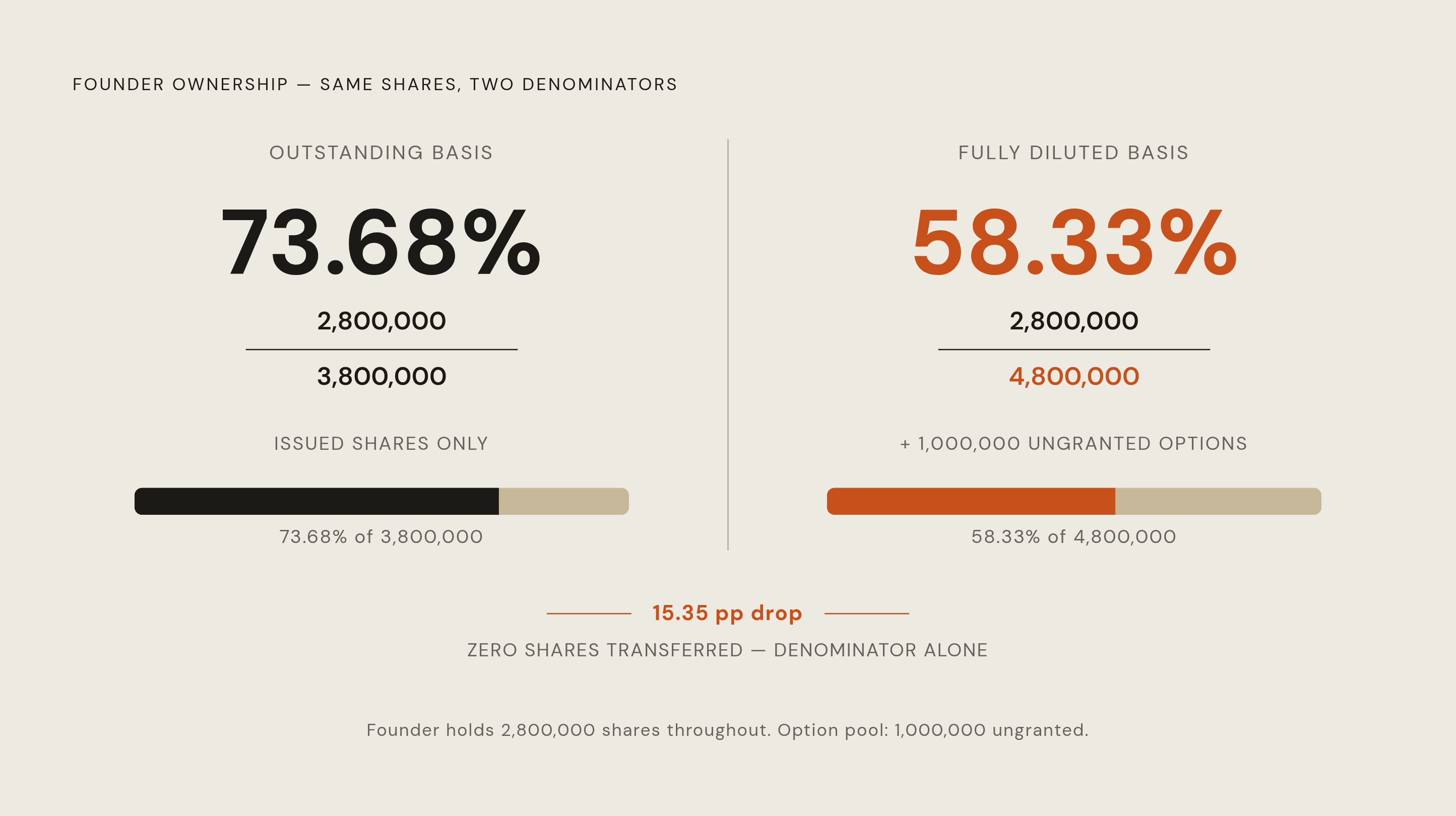
Consider a concrete example. A founding team holds 2,800,000 shares. On an outstanding basis, that equals 73.68% of the company. But once the option pool is counted in the denominator, the same 2,800,000 shares equal only 58.33% on a fully diluted basis. Same shares, different denominator, different answer. Investors focus on fully diluted post-money ownership. Employees should expect their percentage on a fully diluted basis too. The practical instruction follows directly: never accept an equity percentage without asking which denominator produced it and what date the cap table reflects.
What is already in the fully diluted denominator before you join
Your ownership percentage is calculated against a denominator that includes shares nobody has earned or exercised yet. That is by design, not an oversight. The option pool's reserved but ungranted shares sit in the fully diluted denominator immediately. The reserved pool means that portion of the company is already spoken for, even if no option has vested and no one has exercised a single share. If a company has a 15% option pool and you are granted 1% of fully diluted shares, your percentage is already calculated against a denominator that includes the remaining 14% of ungranted pool. Those shares will eventually go to future hires, but they are already reducing your percentage today.
SAFEs and convertible notes that a company has already committed to also inflate the fully diluted count, because they are included on an as-converted basis. Warrants held by venture lenders or strategic partners appear in the same denominator, and they are less visible because they rarely come up in the offer conversation. Warrants are less common at seed stage but appear regularly in growth-stage venture debt, and they dilute on a fully diluted basis from the moment they are issued. The practical question for any offer is simple: what is actually in the fully diluted count today? A company that has raised two SAFEs and has an 18% option pool already has a denominator meaningfully larger than its outstanding share count. An offer quoted as "0.5% of the company" may be 0.5% of a denominator that is already stretched.
How the option pool shuffle moves dilution onto founders and early employees before the round closes
When investors require an option pool to be created or expanded pre-money, they are deciding who pays for the dilution from those shares. The mechanism is clean and unforgiving. The pre-money valuation is divided by the fully diluted share count after the pool is created. That lowers the per-share price. The investor gets more shares for the same dollar. The pool's dilutive cost lands entirely on founders and early employees, not on the new investor. A pre-money option pool dilutes founders, not investors. If the term sheet requires enlarging the pool pre-money, the pre-money denominator rises and existing holders absorb the extra dilution.
The math shows how the shuffle works. An investor prices a round at an $8 million pre-money valuation on a fully diluted basis of 4,800,000 shares, including a 1,000,000-share option pool. The price per share works out to $8 million divided by 4,800,000, or $1.6667. The new investor buys 1,200,000 shares for $2 million. After the round closes, founders end up at 46.67% fully diluted rather than the 56% ratio they might have expected on an outstanding basis. The headline valuation never changed. The dilution disappears from the deal announcement but lands squarely on the cap table. That is why "option pool shuffle" exists as a term of art.
For an early engineer, the consequence matches what founders feel. The grant was sized against a fully diluted denominator that got larger after the pool expansion, so the quoted percentage can shrink without any new shares being issued to them. You might object that the pool funds hires who build value, and that is true. But the real question is who pays for the pool's dilutive cost. A post-money pool spreads that cost to the new investor proportionally. A pre-money pool concentrates it on existing holders. The company's economic outcome is the same either way. The distribution of the burden is not. Founders have pushed back by presenting a realistic 18-month hiring plan with named roles and market-rate option grants. A pool sized for actual hiring needs is materially smaller than a generic 15 to 20% ask.
How SAFE stacks compound the denominator at conversion
Multiple SAFEs convert all at once at a priced round, and their cumulative dilutive effect at that moment is routinely larger than what founders or early employees modeled when each instrument was signed. SAFEs convert into shares based on their valuation cap, any discount rate, and the price of the priced round. So the share count they produce is not fixed until conversion day. If the round prices lower than the cap implied, the SAFEs convert into more shares than anticipated. This stacking effect is one of the most common sources of dilution surprise for seed-stage founders.
For an engineer who joined between SAFE rounds and a priced round, the grant was calculated against a fully diluted denominator that included the SAFEs on an as-converted basis at the time. But the actual conversion can produce a different and larger share count if the round prices differently than the cap suggested. Post-money SAFEs, where the cap is calculated on a fully diluted post-money basis, now dominate at pre-seed. That makes the dilutive math more predictable than with pre-money SAFEs. It also means the SAFE holder's ownership is protected in a way that concentrates remaining dilution on common holders, including early engineers. The practical ask at a pre-seed or seed company is specific: how many SAFEs are outstanding, what are their caps and discounts, and can they show a pro-forma cap table after the next anticipated priced round rather than just the current fully diluted count.
What happens to your percentage across a normal funding sequence
Dilution from successive priced rounds compounds in a predictable direction. Each round issues new shares to new investors, and the fully diluted denominator grows with each issuance. Everyone who was not part of that round sees their percentage shrink. Seed, Series A, Series B, each one sells a percentage of the company to new investors. Those percentages compound across rounds rather than adding linearly. It leaves you holding a smaller slice of a larger pie twice over.
The practical implication for an engineer is that a grant representing a given percentage of the fully diluted cap table at pre-seed represents a materially smaller percentage of a much larger denominator at Series B. Every new round and every option pool expansion adds shares that dilute existing holders. IPOs add another layer, because companies often issue new shares to raise capital at listing, diluting all existing shareholders including employees whose options vested long before. Acquisitions paid in stock rather than cash also issue new shares, diluting existing holders, and that is another downstream event your grant letter never mentions. Even when your ownership percentage is cut in half by a round, the dollar value of your stake can increase if the company's valuation grows faster than your ownership shrinks. The question is never just how much you are diluted. It is whether valuation growth outpaces dilution. Treat your grant percentage as a starting position on a path that reliably runs downward in percentage terms, and model what the dollar value of the stake is at a realistic exit valuation, not what the percentage is at grant.
What information you actually need from a company to evaluate your equity
An equity grant only becomes evaluable when you have four specific numbers: your share count, the total fully diluted shares outstanding, the most recent preferred price per share, and the vesting schedule. Any company serious about attracting engineers should provide all four without being asked twice. Your share count from the grant letter tells you nothing without the denominator. Your cap table should show both your ownership percentage and the price per share, and if you do not have access, ask your company's finance or people team for your current share count and total shares outstanding. Total fully diluted shares outstanding, not outstanding shares and not authorized shares, is the denominator that matches how investors and term sheets treat your equity. The most recent preferred price per share lets you calculate what your grant is worth at current valuation. Divide the strike price by preferred price to see how much of the value is already baked into your exercise cost. Multiply share count by preferred price to get a rough current-valuation figure for your stake.
Ask specifically about the option pool: what percentage of fully diluted shares is reserved, how much of that is ungranted, and whether a new pool will be required at the next round. Ungranted pool shares are already in your denominator, and future pool expansions will grow it further. Always confirm whether the term sheet uses outstanding or fully diluted shares, and model scenarios in a cap table tool before signing. Ask about outstanding SAFEs and convertible notes: how many, what are the caps and discounts, and what does the cap table look like after their conversion at the anticipated next round price. Request a "% fully diluted" column on the cap table, not just a "% of outstanding" column, because the difference between those two figures is the size of the gap this whole piece has been describing. A proper cap table includes columns for holder, security type, shares, percentage of outstanding, and percentage fully diluted. Any company that promises "5%" without naming the denominator and the cap table date is asking you to accept a number with no fixed meaning. A company that cannot or will not provide these details is telling you something about how it operates. Transparency on cap table details is table stakes for a well-run engineering org, not a negotiating secret.

