Cliff and Vesting Schedule Variations at Early-Stage Startups
Understanding why the standard four-year vest with a one-year cliff actually works.
The four-year vest with a one-year cliff is not an accident of industry habit. It encodes specific protections for investors, founders, and engineers at the same time, and knowing what each piece protects is what makes every later deviation readable. Equity under this structure is earned over time as the engineer continues working. An employee who leaves before the schedule finishes forfeits whatever hasn't vested, and that unvested chunk reverts to the company's option pool. If shares were early-exercised instead, the company holds a repurchase right over the unvested portion.
Three forces kept this structure standard. The cliff acts as a trial period built directly into the equity: most co-founder and early-hire conflicts surface within the first year, so the cliff makes sure nobody walks away with meaningful ownership before the company knows whether founder and early hire are a lasting fit. The four-year total lines up with typical fundraising cycles, so a company has enough runway to reward the people who actually build the thing before the next major liquidity event arrives. And investors push for vesting, even on founder shares at incorporation, because they don't want dead equity sitting on the cap table: large ownership stakes held by people no longer doing any work.
Put together, the schedule is a filter and a clock. The cliff filters out short-term noise. The four-year window sets the clock to match how long it actually takes a startup to prove itself. Every variation discussed later in this piece changes one of those two mechanisms, so it helps to hold this baseline firmly before looking at what gets bent.
The Cliff and the Four-Year Mark
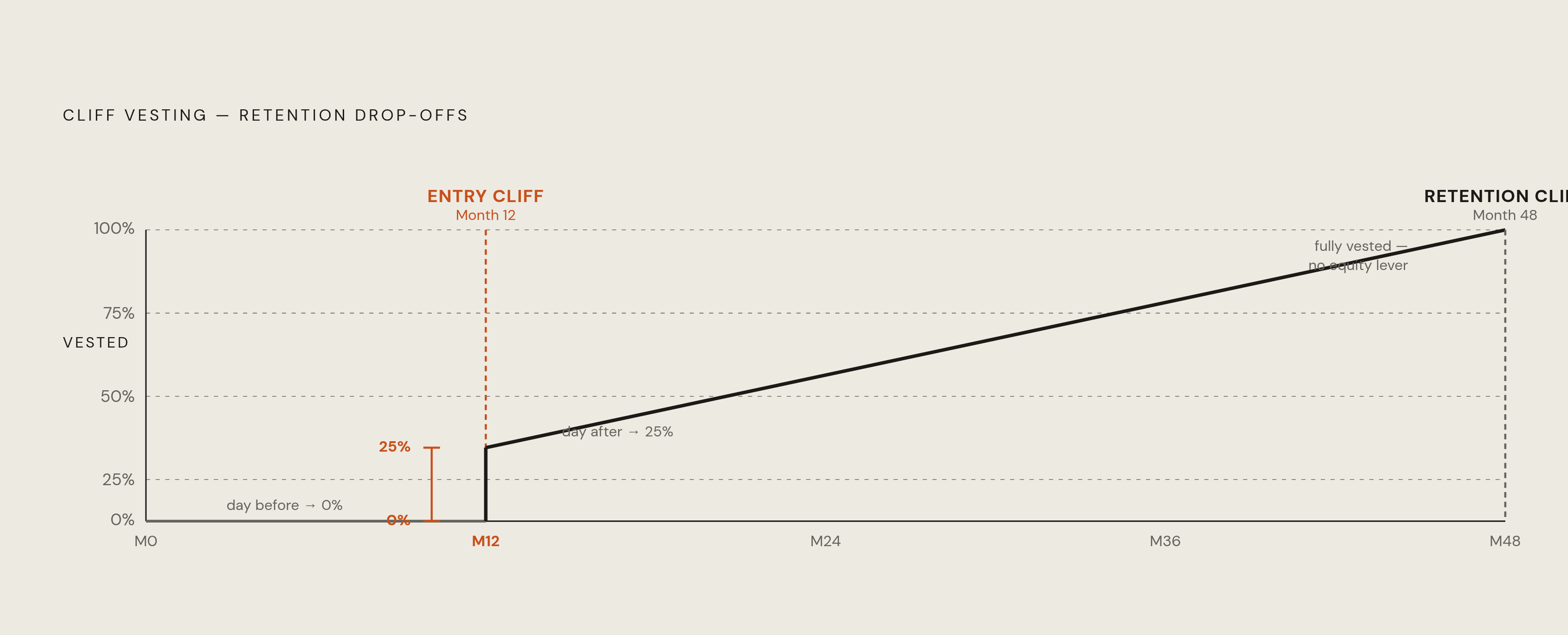
The standard schedule creates two predictable points of friction for engineers, one at month 12 and one at month 48, and both come from the design itself rather than from bad luck.
At month 12, vesting is a hard binary. An engineer who leaves one day before the cliff gets nothing. An engineer who leaves one day after keeps 25% of the grant. That binary produces a perverse incentive to stay just past the cliff date and then leave, which is the behavior the cliff was built to prevent. A meaningful share of startup employees leave before they hit the one-year mark, so they forfeit the entire grant. Another sizable group leaves between year one and year two, keeping only what vested in that window. Both outcomes cluster at predictable moments, because the schedule itself creates the cliff edges where people fall off.
The month-48 problem appears for the people who stay through the full schedule. A fully vested senior engineer has no further equity tied to staying, because the grant has already paid out in full. That's the retention cliff: four years of loyalty rewarded with a schedule that gives the company nothing left to offer unless it issues something new. The standard fix is a refresh grant, a fresh tranche of equity issued before the original grant fully vests, so there's always a forward-looking stake on the table. Without refresh grants, a company's best-retained engineers are also its most likely to start interviewing elsewhere the moment the four-year clock runs out.
Why early-stage startups deviate from the standard, and what kind of pressure produces which variation
Every deviation from the 4-year/1-year standard is a company's response to a specific pressure, not random generosity and not a red flag by default. The pressure might be a competitive hiring market, an unusual role, a senior candidate with real leverage, or an investor's concern about the cap table. Reading the variation correctly means identifying which of these pressures produced it.
A shorter cliff, six months instead of twelve, usually signals that the company is prioritizing a fast close over maximum protection against early departures. The company is accepting more risk that a hire doesn't work out in exchange for closing the deal quickly, and the engineer benefits from less all-or-nothing exposure if the role turns out to be the wrong fit.
No cliff at all, meaning graded vesting starting immediately, is more common in corporate settings than in startups. Seeing it at a startup signals either an unusually high degree of trust in the hire or a relationship that doesn't fit the standard employee mold, often something closer to a co-founder arrangement. Treat it as a positive sign if the role genuinely functions like a founder role. If it's a standard engineering hire, the structure is unusual enough to ask about directly.
A shorter total vesting period, two to three years, can look like a gift on paper, but it carries two separate warnings. It may reflect that the company expects a short runway to an exit, or that it's in an unusually competitive hiring moment and had to sweeten the offer to win the candidate. It's also the deviation most likely to get renegotiated: a shortened vesting period tends to raise eyebrows with investors and often gets rewritten at the next financing round, so a two-year vest offered today may not survive contact with a Series A. So ask what refresh grants look like before you treat the shorter timeline as pure upside.
A longer total vesting period, five to six years, is the one deviation at an early-stage U.S. startup that reliably deserves pushback. It doesn't track any competitive dynamic in the market. It's an asymmetric ask, stretching out the engineer's risk and commitment well beyond what the company's own fundraising and growth timeline would justify.
Milestone and hybrid vesting: where the theory is clean and the practice breaks down
Milestone vesting sounds like the fairest idea in the entire conversation: tie equity to what someone actually builds or achieves, not just how long they sit in a chair. The theory is clean. The practice, especially at early-stage companies, tends to fall apart.
Vesting structures come in three types: time-based, milestone-based, and hybrid. For startups, vesting is almost always time-based, and the reason comes down to a basic problem with milestones themselves: the goals that matter most to a startup are rarely fixed or objective enough to hold steady over multiple years. Milestone vesting runs into a specific set of failures as a result. Fair and objective milestones are hard to define up front. Ambiguous milestone definitions create tension and disputes down the line. And milestones are difficult to administer as a company's strategy shifts, since a KPI that mattered at the seed round or Series A can turn irrelevant after a pivot.
Where milestone vesting does work is in narrower, more contained engagements: advisors, contractors, or part-time contributors with a defined project scope. In those cases the deliverable is concrete enough to specify upfront, and the engagement itself is finite, so the structure doesn't have years to drift out of alignment with reality. Hybrid structures that blend time and milestone vesting appear more often at later stages. Series C companies and beyond are more likely to run sophisticated equity programs that mix in performance vesting or hybrid milestone structures. At Series A and B, refresh grants and executive acceleration tend to do that retention work instead.
Negotiators at AI companies are increasingly asking for performance-based equity triggers that vest early when specific deployment milestones are hit. This pattern is emerging, not yet a mainstream structure at early-stage companies broadly.
The practical takeaway inverts what most engineers expect walking in. Milestone vesting sounds like it rewards performance, which sounds engineer-friendly. If a seed or Series A company offers milestone-based vesting on a core grant, get the milestone definitions in writing before signing anything. Without clear, written, pre-agreed milestones, performance vesting becomes a lever the company controls entirely, deciding after the fact whether the bar was met.
Acceleration Clauses: Rarity and When to Ask
An acceleration clause lets equity vest faster than the original schedule when a specific trigger event occurs, most commonly a change of control such as an acquisition. These clauses can change what an acquisition is worth to an engineer by a wide margin, but they appear in a small minority of employee grants and are written conservatively even when they do appear.
There are two structures worth knowing. Single-trigger acceleration vests equity the moment a change of control happens, and no other condition is required. This is uncommon for employees. Double-trigger acceleration needs both a change of control and an involuntary termination after it. When acceleration shows up in employee agreements at all, double-trigger is the standard form.
Only a small minority of standard employee option grants include any acceleration provision, a much smaller share than founder grants typically carry. Among the employee grants that do include acceleration, most use double-trigger. Single-trigger acceleration for non-founder employees is rare, so if you see it, ask directly why. One recommendation from the investor side of the table: either skip acceleration provisions entirely, or limit double-trigger partial acceleration to the executive team, because a broad acceleration policy can seriously complicate a company's chances of a clean exit. Acquirers don't want to pay change-of-control bonuses across an entire workforce at closing.
Geography matters here too. Roughly a third of European startups offer full accelerated vesting to all employees, a practice that would be unusual at a U.S. company. An offer from a company incorporated where this practice would be unusual, with broad single-trigger acceleration for all employees, deserves a closer look before assuming it's purely favorable.
The more senior and harder to replace the role, the more reasonable it is to ask for acceleration. A founding engineer or an early technical lead has real standing to negotiate for it. A mid-level engineer joining after a Series A generally does not have the same leverage to make that ask.
AI-Era Compensation and Grant Size
The 4-year vest / 1-year cliff is holding steady as the default structure even as AI-driven competition for talent pushes up the dollar value sitting inside that structure. The schedule itself is changing less than the size of the number attached to it.
Equitybee's Startup Employee Equity Grant Report 2026 found that AI and Data companies carried an estimated 27% adjusted grant-size premium over other industries, a gap large enough to matter when benchmarking any offer in that space. Engineering and Product roles consistently get larger grants than other functions once you account for seniority, stage, geography, and company practices. Equitybee's H1 2026 data shows Engineering grants running roughly twice the size of Sales grants at the same company, a useful baseline for ML engineers, research engineers, and robotics specialists comparing their offers against non-technical peers.
AI labs also run genuinely different instruments underneath a schedule that looks familiar. OpenAI uses PPUs, Profit Participation Units, while Anthropic uses RSUs, Restricted Stock Units. Both structure grants over four years with tender offers for liquidity happening roughly once a year. The vesting timeline often still looks like the standard 4-year/1-year cliff, but the strike-equivalent economics differ substantially from a standard ISO grant, and the details of the cap matter enormously. Anyone evaluating one of these offers needs to read the fine print on the instrument itself, not just the headline grant size.
Flexible vesting is growing as a practice, though it hasn't displaced the standard. Companies are increasingly customizing schedules by role, seniority, or individual negotiation at hire, particularly for senior and staff-level engineers. The 4-year structure remains the baseline every one of these customizations departs from.
Reading a Non-Standard Vesting Offer
No single deviation from the standard schedule is automatically good or automatically bad for the engineer looking at it. The real question is whether the deviation reflects a company's genuine constraints and intentions, or whether it quietly shifts risk onto the engineer without saying so, and that question has a structured way to get answered.
Start by identifying exactly which element of the schedule has been changed: the cliff length, the total vest duration, the shape of the schedule (front-loaded or back-loaded), a milestone condition, or an acceleration term. Each of these elements carries its own logic, so the questions to ask depend on which one is different from the standard.
From there, match the change to the pressure that likely produced it. A shorter cliff or a shorter total vest usually points to competitive hiring pressure or a senior candidate negotiating from leverage, and it's generally favorable to the engineer as long as the company is a legitimate, well-run business. A longer vest of five to six years at an early-stage company has no real market justification and is worth pushing back on directly. Milestone conditions attached to a core grant call for written definitions before signing, since vague or undefined milestones leave the company in full control of whether the equity ever vests. No acceleration clause at all for employees is simply market standard and not something to flag. Broad single-trigger acceleration offered to every employee is unusual enough that it deserves a closer look at the reasoning behind it before treating it as a clear win.
Regardless of how the initial grant is structured, ask directly about refresh grants, since the retention cliff at year four is a known, well-understood problem across the industry. A company with no stated policy on refresh grants is either not yet thinking seriously about long-term retention or hasn't reached the size where that policy gets formalized, and either answer is useful to know before accepting an offer.
The exercise window deserves a direct question too. Ninety days post-termination is the default, but some companies extend that window to one year, five years, or even ten, and an extended window is a meaningful signal that the company is building equity terms with the engineer's interests in mind.
For anyone evaluating an offer from an AI lab specifically, the instrument type, whether it's a PPU, a profit interest, an ISO, or an RSU, needs to be assessed separately from the vesting timeline itself. The schedule can look entirely standard, but the underlying economics can work very differently. And for any offer with a shortened vesting period, ask directly whether that schedule is subject to change at a future financing round, since a shorter vesting period agreed to today is often renegotiated once new investors are at the table, so the two-year vest an engineer signs now may not be the two-year vest still in place by Series B.