Post-Termination Exercise Windows at AI Startups
Tax law, not caution, explains why startups give you 90 days to buy your vested options.
The 90-day post-termination exercise period that shows up in nearly every startup option plan is not a penalty written in by a cautious legal team but a direct consequence of federal tax law. Most U.S. private companies grant incentive stock options, or ISOs, because ISOs give employees a real tax advantage over the alternative, the non-qualified stock option. That advantage comes with a condition set by the IRS: the favorable treatment only holds if the option is exercised within three months of the employee leaving the company. Once a company builds its option plan around ISOs, the 90-day clock gets built in right alongside it, because the plan and the tax code are reinforcing the same deadline.
Vesting and ownership get treated as the same thing in casual conversation, but they are not. Vesting means an employee has earned the right to buy shares at the strike price fixed on the day of the grant. It does not mean the employee owns those shares yet. The post-termination exercise period, or PTEP, is the window during which that earned right has to be converted into an actual purchase. Missing it makes the right disappear permanently, regardless of how long the employee worked or how much the company grew in the meantime.
What happens to the shares themselves after that is mechanical and unsentimental. Options that expire unexercised return to the company's option pool, where they can be granted to someone else. The company loses nothing in this transaction. The employee loses everything they spent years vesting toward. That asymmetry is baked into the structure, not an accident of any particular company's policy, and it is the starting point for understanding everything that follows: why the deadline exists, why it creates financial pressure, and why some companies have chosen to move away from it despite the costs of doing so.
The two-sided financial trap engineers face at the 90-day deadline
The 90-day window forces a major financial decision at the exact moment an engineer is least equipped to make it. Employment has just ended, whether by resignation or layoff. The paycheck has stopped. And now, with no income from the company, the departing engineer has to come up with cash to buy shares that cannot be sold on any public market.
Exercising options costs money in more than one way. There is the exercise cost itself, the strike price multiplied by the number of shares. For ISOs, there is also the possibility of triggering the Alternative Minimum Tax, a separate tax calculation that can apply even though no actual cash has changed hands from a sale. Consider a simplified version of what this looks like in practice: an engineer holds options with a strike price far below the current share value, as set by the company's latest 409A valuation. That spread, multiplied across thousands of vested shares, can generate an AMT bill running into the tens of thousands of dollars, due in the same tax year as the exercise, with no sale of stock to cover it. The shares bought with that cash are illiquid. There is no guarantee of a future liquidity event that would ever turn them back into cash.
Switching to non-qualified stock options does not solve the problem, it just changes its shape. Exercising an NSO triggers ordinary income tax on the spread between the strike price and the current value, due at the time of exercise, along with payroll tax. That is a different tax bill arriving through a different mechanism, but it is still a tax bill due immediately, on an asset the employee cannot touch.
These two pressures, the exercise cost and the tax bill, do not arrive one after another with room to plan between them. They land at the same time, inside the same 90 days, while the underlying stock remains locked up with no resale market. An engineer weighing a five-figure or six-figure cash outlay against a stake in a company they no longer work for, with no way to know when or whether that stake will ever be worth cashing in, is often making a rational choice to simply let the options expire. That outcome is the predictable result of a structure that ties a large financial commitment to a hard deadline and an illiquid asset.
The deeper issue with this structure is who it favors. Whether an employee exercises vested options comes down largely to whether they have cash sitting around at the moment they leave, not how long they stayed or what they built while they were there. An engineer with savings can exercise and wait. An engineer without that cushion forfeits equity they earned through the same work, at the same company, over the same years. The 90-day window, applied uniformly, produces a very uneven result.
What your option agreement says about your window
The exact terms of the post-termination exercise period live in the option agreement, and the clause doing the real work is usually easy to miss on a first read. It sets both the length of the window and the conditions under which different lengths apply. Voluntary resignation, layoff, termination for cause, and death or disability frequently carry different windows in the same document, so the circumstances of departure matter as much as the departure itself.
Before any decision gets made, confirm directly from the paperwork the exercise cost, the taxes likely to be owed at exercise, and the precise length of the window given the actual reason for leaving.
Two pieces of language are worth locating specifically. The first is the definition of "Termination Period" or "Termination Date," because this sets when the clock actually starts. That date is typically the last day of active service, not the last day of a notice period, and not the end of any garden leave the company may have granted. The second is the expiration date printed on the original grant itself, often ten years from the grant date. That outer date caps everything. Even a generous extended PTEP offered by the company cannot push an exercise deadline past the grant's own expiration date. Whichever of the two comes first, the stated PTEP or the grant's expiration, is the one that governs. An engineer whose ten-year grant is already nine years old may have far less time to act than the PTEP alone would suggest.
Most engineers sign these agreements at the start of a job, focused on the offer and the salary, without working through what the termination clause actually says. The deadline and its tax consequences tend to surface for the first time only after a severance letter or a resignation is already in motion, the worst possible time to be learning the rules.
Reading the agreement carefully answers the question of when the deadline falls, but not what it will cost to meet it. For that, an engineer needs the company's current 409A valuation to calculate the spread between the strike price and the present fair market value, and ideally a tax professional to estimate potential AMT exposure before committing any cash. The contract sets the date. It says nothing about the price of acting on it.
How ISO status, NSO conversion, and extended windows interact on taxes
The most common misunderstanding about extended exercise windows is the assumption that a longer company deadline also preserves ISO tax treatment, and it does not. Even when a company allows exercise years after departure, the conversion from ISO to NSO status still happens at the original 90-day threshold set by federal tax law. The company can extend how long you're allowed to exercise. It cannot extend how long the IRS gives you to do it as an ISO.
Extending the post-termination exercise period on a previously granted ISO counts as a modification of that option, and the modification causes the ISO to lose its status. The right to exercise can still be extended for years, but any exercise that happens after the original 90 days gets taxed as ordinary income at the time of exercise, the same as an NSO, rather than qualifying for long-term capital gains treatment down the road.
That produces a real trade-off, and it cuts in both directions. An extended window gives an engineer more time and more flexibility than the standard cutoff ever would. But exercising during that extended period means exercising as an NSO holder, with the tax bill due immediately at exercise. More time is not the same as better tax treatment, and the two should not be confused.
The risk profile shifts along with the tax treatment. ISOs exercised within the original qualifying window carry AMT exposure. NSOs exercised later, under an extended window, carry ordinary income tax exposure instead. Neither path is free of cost, just differently structured.
One approach threads both regimes at once. An engineer who knows they are leaving can exercise a portion of vested ISOs before the 90-day window closes, locking in ISO treatment on those shares, and then let the remaining options convert to NSOs under the company's extended window if one exists. That split captures the tax advantage where it is still available and keeps flexibility on the rest, rather than forcing an all-or-nothing choice at departure.
What it costs a company to extend the PTEP
Companies that keep the standard 90-day window are not necessarily indifferent to what happens to departing employees. Extending that window creates costs that boards and investors take seriously, and those costs explain why the 90-day default remains so common even among companies that would otherwise want to be generous.
The first cost appears on the cap table. Options that sit unexercised while a former employee decides whether to act stay outstanding instead of returning to the pool, diluting every other stockholder and option holder for as long as that decision gets delayed. Under the standard 90-day model, expired options flow back into the pool quickly and get reissued to new hires. Extend the window, and the pool depletes faster without that return flow, often forcing an earlier pool expansion. Expanding the pool requires a board vote and dilutes every existing holder, not just the departing employee's former peers.
Investors and investor-appointed board members frequently have strong views on extended exercise periods, sometimes treating the practice as a warning sign about how a company manages its cap table. A company weighing an extension should expect pushback not only from the investors already on its board but from new investors evaluating the cap table in a future financing round.
There is also a fairness argument that runs the other way from the one engineers tend to make. Critics of extended windows describe them as a transfer of value from employees who stayed and kept building the company to former employees who left, since dead equity sitting in former employees' hands dilutes the people still doing the work. Boards considering an extension should expect this argument to arise among employees who stayed, because it is a real tension, not a rhetorical one.
Extending the window also removes a retention mechanism that companies may not openly discuss but quietly rely on. When exercising options requires cash an employee does not have, that inability can function as a kind of golden handcuff, keeping people in their seats longer than they otherwise would stay. Extend the window, and that pressure disappears, which can accelerate departures the company would rather have delayed.
Cooley's standard guidance to startup clients reflects this balance: default to the 90-day window, and handle extensions case by case at the board's discretion. That approach preserves ISO eligibility for the workforce as a whole, limits how much unexercised equity is on the cap table at any given time, and still gives the board room to make an exception for a specific person worth rewarding.
Companies that have extended, and their actual terms
A number of companies, often ones whose valuations climbed fast enough to make the standard 90-day window genuinely punishing for departing employees, have moved to extended exercise periods. The terms differ sharply from company to company, and none of them get around the ISO conversion rule described above.
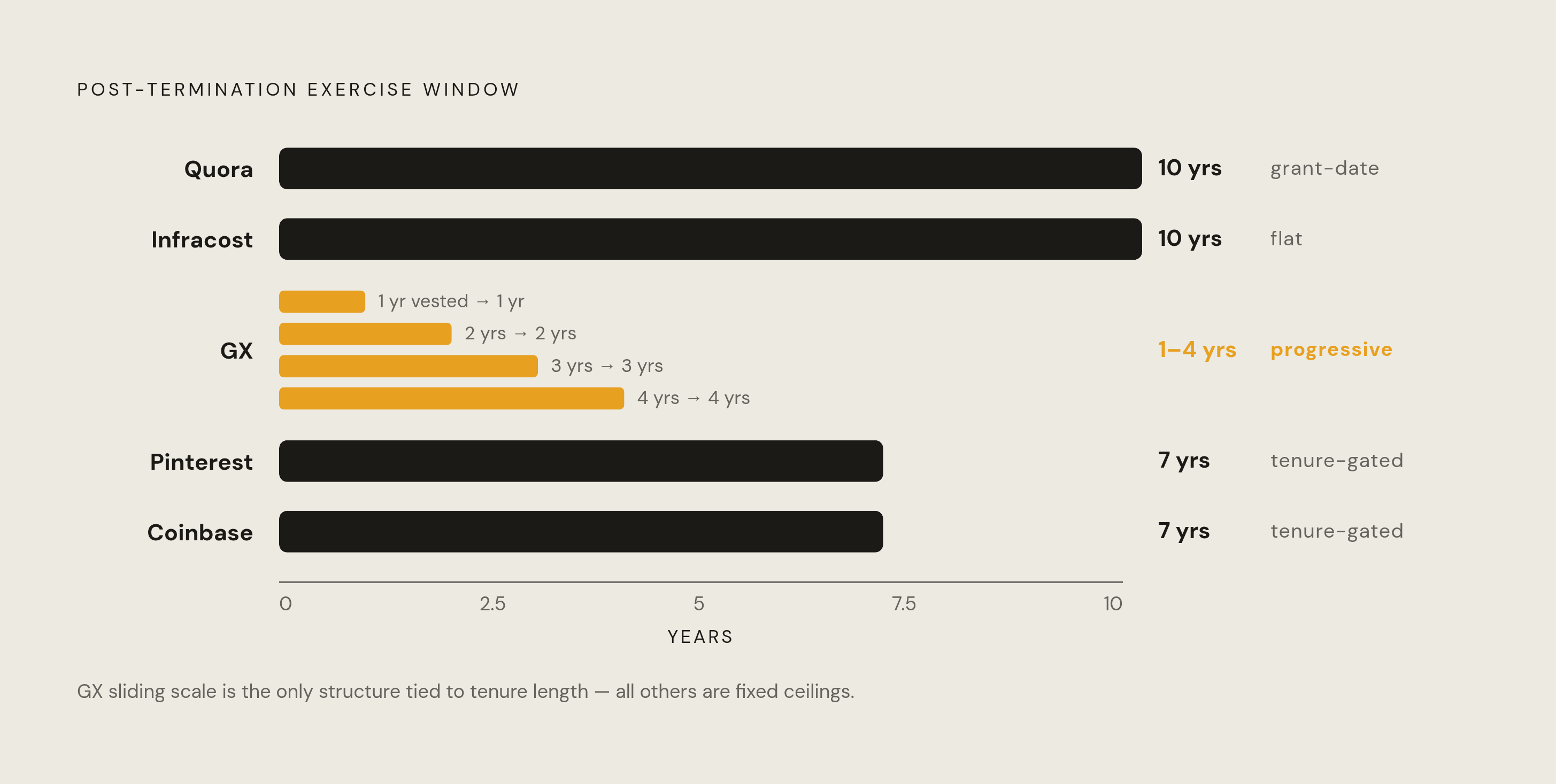
Pinterest adopted a seven-year post-termination exercise window, reportedly available to employees after two years with the company, a response to rising valuations and transfer restrictions that made the standard short window especially costly to departing staff.
Coinbase extended its window from 90 days to seven years for new employees who join and stay at least two years, a policy the company announced in August 2015 and framed explicitly as a response to the retention pressure created by short windows.
Quora adopted a ten-year window measured from the grant date itself, back in 2014, making it one of the earliest companies to move in this direction.
GX uses a tenure-based sliding scale: one year of vesting earns a one-year extended window after termination, two years earns two years, three years earns three years, and four years earns the maximum four-year window.
Infracost gives employees a full decade to exercise. Its co-founder, Hassan Khajeh-Hosseini, built that policy in direct response to his own experience at RightScale, where his early options expired before the company was acquired by Flexera.
These models differ in a way that matters to anyone evaluating an offer. Tenure-gated structures like Coinbase's and Pinterest's reward employees for staying longer. Grant-date structures like Quora's start the clock on day one. The effective window can run out sooner than a termination-date model with the same stated length. Progressive models like GX's scale the benefit directly to time actually served. None of these is simply a longer version of the 90-day default. Each changes the incentive it creates.
Workarounds available to engineers who face the 90-day window today
Engineers at companies still running the standard 90-day window are not entirely out of options. Several workarounds exist, each carrying its own trade-offs, and knowing them before a departure is underway lets an engineer capture vested equity that would otherwise be lost.
Negotiating an individual extension at the point of departure is possible, even at companies with no stated extended-window policy. Boards can and do make one-off exceptions, particularly for employees leaving on good terms whom the company wants to keep goodwill with.
Laid-off employees in particular have room to negotiate. One path is converting ISOs into NSOs after the standard window closes and then negotiating a longer exercise period on those converted options. Employees who already hold NSOs can skip the conversion step and simply ask for an extension directly.
Any negotiation to modify a previously granted ISO runs into a technical constraint: an offer to modify the option cannot stay open for more than 29 days, or the option loses ISO status regardless of whether the employee ever accepts the offer. That rule shapes how quickly a departing engineer and a company need to move once the conversation about an extension starts, and it is one more reason to understand the mechanics of the exercise window well before the departure date arrives, not after.
Sources
- Extending Post-Termination Option Exercise Periods: What You Should Know
- Post-Termination Exercise Window: Why It Sucks and What You Can Do About It - Compound Manual
- Post-Termination ISO Exercise: Your 90-Day Window Decision
- GitHub - holman/extended-exercise-windows: A list of startups that have employee-friendly terms for exercising your options past 90 days. · GitHub
- Commonly Considered Option Program Enhancements: Part III
- Stock Options: VC-Backed Startups Extend Post-Termination Exercise Period (PTEP)