What Happens to Vested Options in an Acqui-Hire
Acqui-hire buyers pay for future work, so vested options often get nothing.
In an acqui-hire, vested options often produce little or no payout because the buyer is paying for future work. The key is the two-pool structure, which separates the purchase price from the team’s new compensation.
Why vested options feel like a sure thing — and why acqui-hires break that assumption
The acquisition announcement arrives at the all-hands, and engineers start doing mental math. They count their vested options, subtract the exercise price, and imagine what the sale might pay. The reasoning feels sound enough to trust. Vesting means earning, and a sale looks like the moment those earnings turn into cash. In a full strategic acquisition, that expectation can hold up.
An acqui-hire breaks the link between those two events. The buyer wants people who will work for it, rather than a company whose existing business justifies a substantial purchase price. Past vesting is not the buyer’s main concern. An engineer can have years of vested equity and still receive nothing for it, while being offered a valuable package to join the acquirer.
What makes an acqui-hire structurally different from a regular acquisition
An acqui-hire buys a team rather than a product, customers, or technology at scale. It commonly takes the form of an asset purchase, in which the buyer acquires selected assets, such as IP and patents, and offers jobs to key employees. Stock purchases, mergers, and license-and-hire arrangements are also possible. Money paid for the company serves a different purpose from money promised to its people.
Pool 1 is the deal consideration, which pays for the acquired assets and goes toward settling the company’s existing claims. It flows through the liquidation waterfall, the order in which investors and other equity holders receive proceeds. Preferred shareholders get paid before common shareholders. Pool 2 is the compensation package offered to the team for future services at the acquirer. It is tied to continued employment and vests over a new schedule.
That is why Pool 1 can be small even when the buyer offers a lot for the team to join. The buyer has placed the value in the people. It therefore puts the deal’s money toward keeping them. Pool 2 is not another route for distributing Pool 1, and years spent earning startup equity do not automatically create a claim on it.
How the liquidation waterfall consumes Pool 1 before options see a dollar
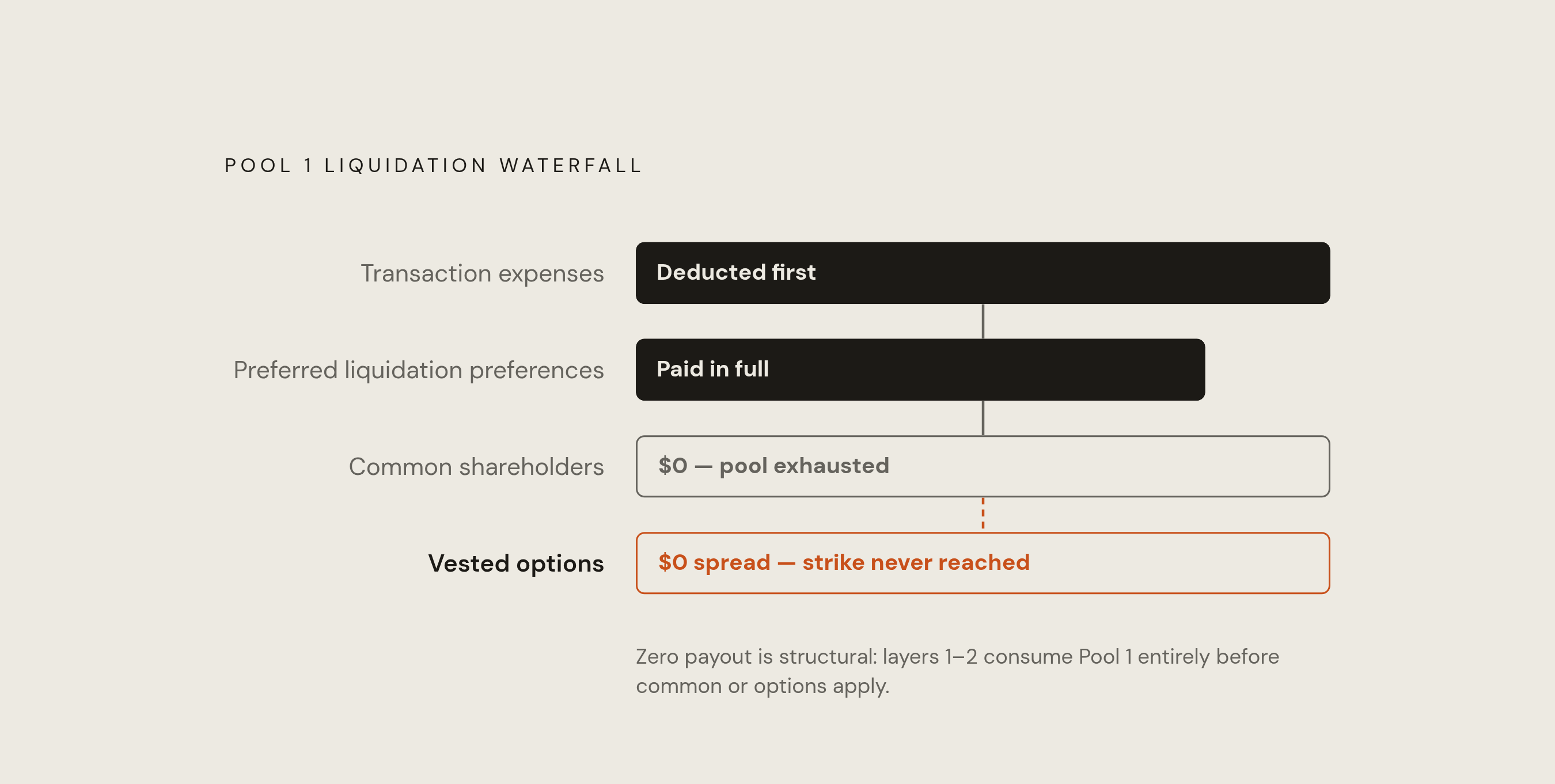
Preferred investors have liquidation preferences that must be paid before any money goes to common shareholders. A vested option’s potential payout depends on what remains for common stock. The strike price is the next hurdle. If the actual consideration per common share is at or below that exercise price, the option has no positive spread to pay out.
Consider a hypothetical asset purchase in which Pool 1 is smaller than the investors’ liquidation preferences. The money flows through the waterfall to pay those preferences, so nothing is left for common shares. Vested options therefore have no spread, regardless of how many an engineer holds. Now suppose Pool 1 is a little larger and some of the money reaches common shareholders. Even then, the options produce no payout if the amount per common share does not exceed their strike price.
Transaction expenses, fully diluted ownership, and other deductions under the deal also change how much goes to each share. The calculation starts with that allocation. Because acqui-hires direct much of their value into Pool 2, their relatively low Pool 1 prices often leave little or nothing after preferences. A meaningful-sounding announcement can therefore coexist with a zero payout for every option holder.
The three fates of vested options at close, and which one acqui-hires produce
Vested options can be cashed out, assumed and converted, or cancelled. In a cash-out, the buyer pays the positive spread between the consideration allocated per share and the strike price, multiplied by the eligible vested option count. The money may arrive within days to a few months of closing. Cash-out is common across acquisitions generally. That broader pattern does not make it a reliable expectation in an acqui-hire.
Assumption and conversion preserve the option in a different form. The buyer replaces it with rights to acquirer equity and uses an exchange ratio to change the number of options and the strike price in a way designed to keep the same intrinsic value. The applicable vesting schedule continues. This is not the same as receiving cash.
Cancellation terminates the option without payment when the transaction provides no continuation or other consideration. Underwater options are usually wiped out this way. Acqui-hires push toward this outcome because the common-share allocation often fails to clear the strike price, while a barely positive spread produces only a small cash-out. Vesting does not prevent that result. Unvested startup options are also generally cancelled unless the acquirer chooses to replace them with a new grant, which is a retention decision rather than an entitlement earned under the old schedule.
What Pool 2 — the compensation package — actually looks like for retained engineers
Pool 2 can include new acquirer equity, a signing bonus, and sometimes a cash retention bonus paid over a fixed employment window. The new equity commonly vests monthly over three to four years. That package can have substantial value for retained engineers. But its fresh schedule makes the bargain explicit, because employees must keep working for the acquirer to earn the future installments. It is not settlement for the years already worked at the startup.
Only employees who receive and accept offers participate in that compensation pool. Engineers without an offer have no claim on it. They receive whatever their shares qualify for from Pool 1, plus any severance the startup can pay from remaining assets. An engineer who joined eight months before the deal can receive more from Pool 2 than a founder with three years of vested startup equity, because the buyer is pricing future services.
In license-and-hire deals, a reverse acqui-hire variant, the original company stays legally intact while key people go to work for the buyer and much of the money goes to them through employment agreements. Google’s deal with Character.AI included a non-exclusive technology license and brought Noam Shazeer, Daniel De Freitas, and a core group of engineers to Google. The company need not be purchased outright for its team to move.
Acceleration provisions and what they can — and cannot — rescue
Acceleration changes when unvested options become vested while leaving the value of the underlying shares unchanged. With single-trigger acceleration, unvested options vest when there is a change of control. It is relatively rare in standard employee grants and appears more often in founder and senior executive packages. Double-trigger protection requires a qualifying termination in addition to the acquisition, typically within 12 to 24 months after close. The second trigger can include an involuntary termination without cause or a material reduction in role or compensation covered by the agreement.
Neither provision fixes an inadequate Pool 1 price. If common-share consideration does not exceed the strike price, newly vested options remain underwater. In the less common acqui-hire case where Pool 1 leaves a large enough positive spread for common options to pay out a meaningful sum, acceleration can help because more options get to share in that money. Partial acceleration may also be offered as a concession, but changing the vesting date alone does not create a payment.
Post-closing acceleration has another limit, because the option must survive the transaction or be assumed with continuing acceleration rights. Most startup employees have no acceleration or change-of-control protection in their grants, so there is no extra contractual benefit to invoke. By the announcement, the existing grant language is already fixed. The earlier window to negotiate that protection has passed, even if the buyer is still discussing new employment terms.
The tax layer that can quietly reduce what Pool 2 actually pays out
Pool 2’s promised value is not the same as take-home pay. Deferred compensation and equity events tied to the deal can bring tax bills that leave an engineer with less to keep. The type of award and the taxable event are important distinctions. For NSOs, a taxable option spread is ordinary income, while ISO treatment can mean owing alternative minimum tax. Acceleration should not be treated as a universal tax event on its own, because vesting, exercise, and cash-out are different steps.
An ISO cash-out can also lose favorable tax treatment. A disqualifying disposition within one year of exercise or two years of the grant date can make the spread ordinary income rather than preserve the intended long-term capital gains treatment. Retention agreements set up as deferred compensation must also meet the rules under Section 409A. A violation can cause immediate income inclusion on the entire vested amount and a significant additional tax, even before payment. The employee bears that cost.
For founders and executives, Section 280G can apply when covered deal payments exceed the statutory threshold, bringing an excise tax and a corporate deduction disallowance. Payment timing presents another risk outside Pool 2. Eligible Pool 1 proceeds may be held in escrow against indemnification claims, so the amount received at close can be smaller than the stated payout. Buyers sometimes offer withholding support or loans as negotiated terms to avoid a liquidity crisis. An engineer who understands those risks before closing still has time to address them in the package.
What engineers can actually negotiate, and when the window to do it exists
Rank-and-file employees generally have no say in Pool 1’s price, the liquidation waterfall, or the transaction structure. The board, investors, and buyer set those terms. For Pool 2, employees can still negotiate employment agreements, the size of new grants, vesting schedules, and acceleration language until they accept the offer. After acceptance and closing, most of that leverage is gone.
Founders and key engineers can push for shorter vesting, such as two years rather than four, to reduce the period of continued-employment risk. They can also seek acceleration for involuntary termination without cause or a project shutdown. Guaranteed minimums and severance floors offer a different protection. Unlike payments tied to milestones the buyer controls, they need not depend on the buyer keeping the original project on course. They can also ask for tax gross-ups or loans to cover withholding when the equity and deferred compensation terms could leave them owing tax.
Before making a decision under deadline pressure, engineers should read the grant agreement, equity incentive plan, and the merger agreement’s “Treatment of Stock Options” section. Exercise deadlines, conversion terms, withholding, and tax consequences deserve attention before close. Missing a deadline can cost an engineer their equity rights even if the other terms are good. The buyer may hold nearly all the leverage in a distressed deal, but that does not make every hiring term fixed. Buyers competing for rare or deep technical skills have a reason to negotiate compensation for the people they want.
Ask about acceleration, change-of-control language, and exercise windows before signing. Funding stage alone does not answer those questions. The engineer doing mental math at the all-hands is too late to rewrite most of the existing deal mechanics, though a new employment offer may still be negotiable. The engineer who understood the two pools before joining knew to ask what protects past equity and what would have to be earned all over again.