Big Tech Equity to Startup Options How ML Engineers Should Translate the Value Gap
A framework for calculating whether startup option gains justify the salary premium at big tech.
ML engineers weighing Series A and Series B AI startup jobs need to check whether the money they could realistically get from options would cover the four-year compensation gap with big tech. That requires translating ownership into proceeds after dilution, investor preferences, exercise costs and taxes, then weighting the possible outcomes. A startup can still be the right career move when the numbers fall short, but that shortfall should be a conscious trade.
Why ML engineers are uniquely exposed to this comparison right now
ML compensation in 2026 is fragmented across frontier AI labs, traditional big tech and startups offering equity and ownership. These employers compete for the same engineers with different instruments. Anthropic and OpenAI offer senior packages that materially exceed Meta and Google at equivalent levels. Secondary tender offers let engineers turn some lab equity into cash from time to time, though there is no formal guarantee that these offers will happen.
That creates a tier between public stock and ordinary startup options. Meanwhile, Carta’s H1 2025 data shows that startup equity grants are still well below pre-2022 levels, even though startup base salaries have risen. Older advice can therefore overstate the equity available today. An engineer comparing a Series A offer with Meta stock needs more than a salary comparison, because the packages have different routes to payment and different ways to fail.
What the actual compensation numbers look like across tiers, level by level
The baseline is total compensation, including base salary, annualized stock and bonus. Base alone is an incomplete benchmark. It undercounts public-company packages where much of the growth comes from RSUs, while generic software engineering benchmarks miss the premium that ML and AI roles receive at startups. An offer needs a role-equivalent comparison before its equity can be judged.
Level names also need translation across companies. At Amazon L4, engineers are entry-level, while at Google L4 they are mid-level. Conflating them can create tens of thousands of dollars a year in benchmarking error. Amazon L6 is senior-equivalent, but its stock schedule makes it especially important to check when that compensation comes in.
Vesting changes what each year actually delivers. Google front-loads vesting, with monthly vesting for large grants and quarterly, semi-annual or annual vesting for smaller grants. Meta uses flat quarterly vesting. Amazon back-loads stock into years three and four, so someone leaving after year two receives only a fraction of the headline stock award. Without actual offers to compare, exact dollar amounts would make the comparison look more certain than it is.
Why RSUs and startup options cannot be compared at face value
Public-company RSUs vest into shares, with the market price at vesting setting their taxable value. That value is taxed as ordinary income. The engineer then has stock that can become cash without waiting for the company to exit. Its price can fall, but liquidity does not depend on finding an acquirer or reaching an IPO.
Startup options work differently from public-company stock awards. They are typically Incentive Stock Options, or ISOs, with a strike price set at the 409A fair market value when granted. The employee must pay that price to acquire shares, and a liquidity event is needed to turn the investment into cash. If the company never exits, the options can expire worthless.
Timing can also force cash out before cash comes in. After leaving, an engineer may have only a short exercise window to pay the exercise bill and may also owe alternative minimum tax, or AMT, with no guarantee of being able to sell. A multi-year window is materially better. Lab tender offers help close this liquidity gap, so frontier lab packages need to be assessed on their own, apart from ordinary startup options.
How dilution silently reduces the equity stake on the offer letter
An ownership percentage describes the stake at the grant date. New financing shares enlarge the denominator and reduce the employee’s percentage. Investors may also ask for an increase in the option pool before a round closes, so existing shareholders bear that dilution and incoming investors avoid it. Employee grants rarely come with the pro rata rights or anti-dilution protections that investors can get.
For a simple hypothetical, start with a 0.5% seed grant. After a financing, multiply that stake by the fraction of ownership left with existing shareholders. After another round, apply the next retained fraction to the already reduced stake, including any option pool expansion.
Ownership is only part of the payout calculation. Liquidation preferences give preferred investors a claim on proceeds before common shareholders receive money. Options convert into common stock. In a modest exit, an engineer can own a real percentage and still receive nothing after those claims are paid.
What exit probability and valuation entry point do to the expected value math
The prudent cash budget values startup equity at zero as a planning assumption. Carta’s H1 2025 data shows that most seed-funded startups, by a wide margin, fail before Series A. An honest model therefore needs to include a zero-payout outcome as well as successful exits of different sizes.
Stage helps, but it does not settle the probability. A Series B company with revenue and a credible exit path is a different bet from a seed company without a product. Entry pricing also needs careful treatment. At the same eventual ownership percentage and exit proceeds, a higher entry valuation alone does not change the employee’s share, but strike price, investor claims and the growth required to justify that valuation can change the economics substantially.
Public stock is not risk-free either, so both sides need discounts. A falling share price reduces RSU value, while a layoff stops future vesting, as Google’s rolling 2026 engineering reductions illustrate. Those risks are more bounded than startup failure, dilution, preference claims and exercise costs combined.
How to build the four-year opportunity cost comparison that actually holds up
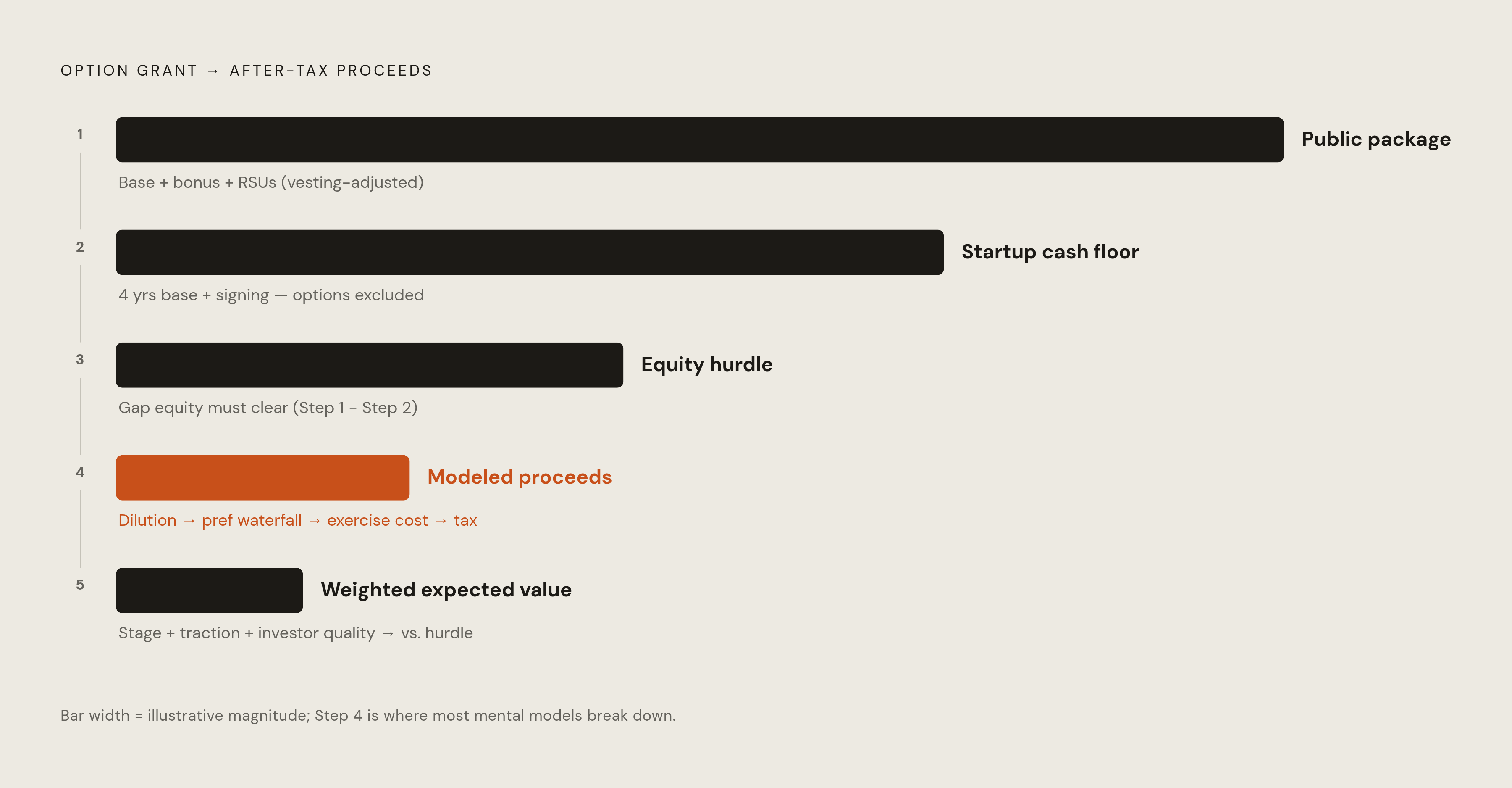
Four years matches the standard vesting commitment on both sides. The useful output is a cash gap that startup equity must cover. To build it, take a hypothetical senior public-company offer and a Series A offer with a 0.5% option grant. The grant percentage is only the starting input, so the calculation must follow it through to money the engineer could actually keep.
Step one is to normalize the public-company package. Normalizing the public-company package requires adding base, bonus and RSUs valued at the current stock price, then placing the stock into the years when it actually vests. Timing must stay visible throughout the comparison. A flat annual average hides Amazon’s back-loading and obscures what the engineer gives up by leaving early. The model should also allow for stock prices to change and vesting to stop, since the full grant may never turn into cash.
Step two is to isolate the startup’s cash floor. Add four years of base salary and any signing or cash bonus, leaving options out for now. How much reaches the engineer’s bank account still depends on taxes and how long the engineer keeps the job. The comparison needs the same employment assumptions on both sides.
Step three is to calculate the compensation gap. Subtract the startup’s four-year cash total from the public-company total, using a consistent tax basis. That gap is the equity hurdle to beat. If the comparison starts with gross compensation, it should not then compare that gross shortfall directly with after-tax option proceeds.
Step four is to model zero, modest and large exits. For each outcome, start with the fully diluted share count and the size of the grant, then reduce the ownership share to allow for the financing and option pool dilution expected along the way. Next, apply the liquidation preference waterfall to find what remains for common shareholders. Only then does the employee’s ownership percentage produce a meaningful payout estimate.
The next subtraction is exercise cost and estimated tax. ISO exercise can trigger AMT, while qualifying long-term capital gains treatment requires holding shares for over one year after exercise and over two years after grant. Both holding periods must be met. A zero-payout outcome also needs to reflect any exercise cash already spent, rather than assuming failure always leaves the employee exactly where they started.
Step five is to weight the outcomes using stage, revenue traction and investor quality, then compare the resulting expected equity proceeds with the gap. The probabilities are judgments. If the weighted proceeds do not clear the hurdle, the offer is a financial trade-down under those assumptions. A claim that a grant will be worth X at a Series C target valuation is useful only if it survives the same dilution, preference, cost and tax calculations.
The variables that change the math enough to shift the conclusion
A founding engineer with a large pre-seed grant and a credible team faces different economics from an engineer joining at Series C with a small grant and a high valuation. Yet revenue and growth are more useful than the stage label alone. A Series A company with strong traction and a path to profitability can be a better equity bet than a Series B company funding an unvalidated product.
Liquidity terms can also narrow the compensation gap. Stripe, Databricks and frontier AI labs are in a group of private companies where secondary tender offers can make equity more like liquid stock. Past access is still not a promise of future access. Investor quality and a multi-year exercise window also deserve explicit treatment because they affect either the chance of a payout or the cost of waiting for one.
AI companies that build on foundation models can bring in meaningful revenue sooner than startups in earlier generations could. That can shorten the wait for useful evidence. An engineer may learn sooner whether the equity case is tracking, then update a career plan or use a secondary sale if one is available. Faster feedback improves the decision process without making the eventual payout certain.
The non-financial trade-offs that belong in the decision but not in the equity math
Taking a job that pays less can still be a good career move. At a Series B company with real users, an ML engineer may be in charge of evaluation infrastructure, fine-tuning, serving and data quality across a production pipeline. That breadth differs from a component role at Google. It can build career capital, but it should not be counted as extra dollars in the option valuation.
The work itself also separates career paths. AI labs suit engineers who want to do foundational model research, while startups suit those who want to build ML products and see them reach users. Application-layer work can make the link between engineering and user outcomes shorter and more visible.
Title acceleration needs a harder look than mission. Becoming a tech lead in one to two years is more useful when senior engineers provide a strong standard to learn against. Without that calibration, a fast promotion can reinforce habits that later need unlearning. The two environments can also complement each other, with two to four years at a well-run big tech company or lab followed by two to five years at a chosen growth-stage startup. The framework makes the price of that move visible before the engineer decides it is worth paying.
What should an ML engineer verify before accepting a Series A or Series B startup offer
The inputs to request are the current fully diluted capitalization and the percentage the grant represents on that basis. Then ask for the liquidation preference terms on outstanding preferred shares. A non-participating preference at the standard multiple is fairly good for employees, while participating preferred or higher multiples can leave much less money for common-stock holders in a modest exit.
Ask for the post-termination ISO exercise window and whether the company has run secondary tender offers or plans any soon. The inputs to request are the current 409A fair market value and the strike price expected for the grant. The preferred share price is not a cash value the engineer can simply assign to common stock.
Finally, ask for current ARR or revenue and runway at the current burn rate. Those answers help distinguish a funded story from an operating business. A refusal to provide these inputs is a warning about how the company treats engineers as parties to the deal. The strongest equity offer is not necessarily the largest percentage, but the one whose terms and business prospects support a credible path to proceeds.